
Recently, many comments in the comment section have asked me to discuss the privacy screen on the Xiaomi 18 Pro—controversy around it has been mounting lately. So today, I’ll break it down for you.
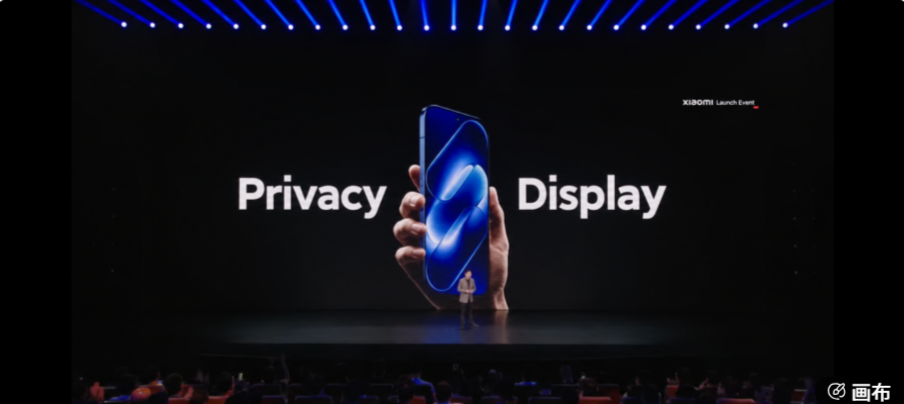
First, you ask: does the privacy screen actually work?
I can confidently tell you: yes—it absolutely does. Otherwise, how could privacy films remain popular for so long?
After applying a privacy film, the viewing angle narrows dramatically—even non-tech-savvy users can instantly notice the difference. Yet privacy films persist, proving clear market demand.
Let’s talk about applicable scenarios.
The next time you’re on public transport or in a crowded elevator, observe people around you using their phones. Without a privacy film, what do you see?
Simply put: you can clearly read what they’re typing or browsing—even from the side. There’s virtually no privacy.
So if you don’t want others seeing your screen, what’s the solution? Simple: apply a privacy film.
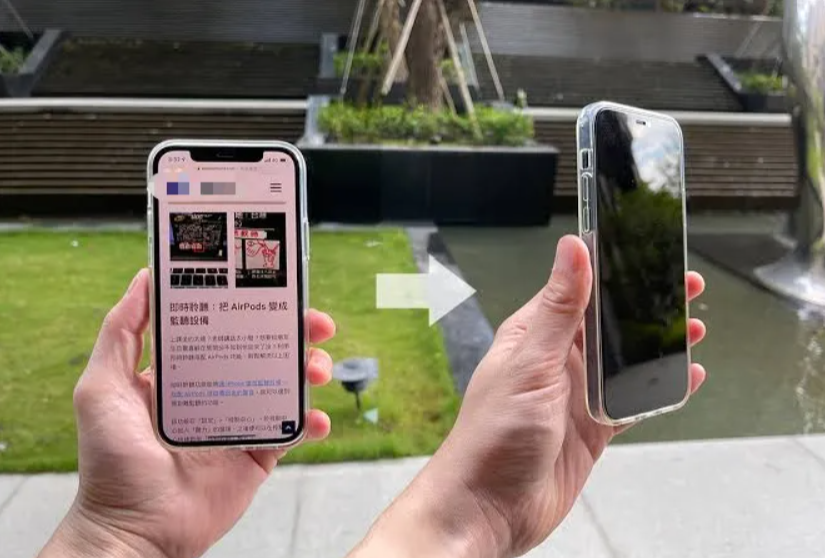
After applying the privacy film, content becomes nearly invisible when viewed from the side—that’s its value.
Of course, if you never use your phone on public transport, avoid using it in offices or elevators, or simply don’t care whether others see your screen, then this feature may indeed be optional.
Regarding smartphone privacy display technologies, there are broadly two categories: privacy screens and privacy films.
The principle behind privacy films is largely consistent across brands—using a ‘venetian blind’ structure. Higher-end films simply deliver better performance.
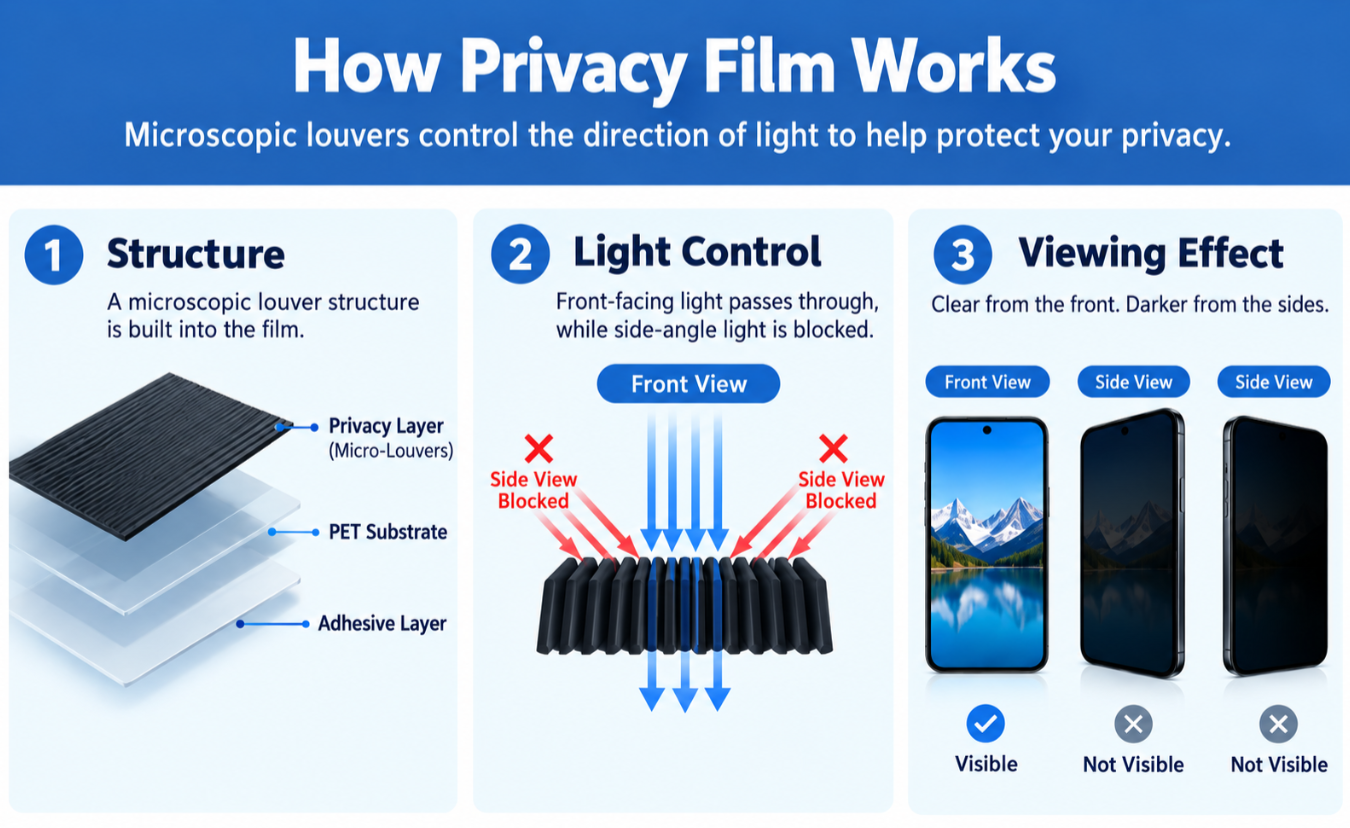
However, within the privacy screen category, technical approaches vary significantly.
Currently, only three smartphone series support built-in privacy screens: the Samsung S26 Ultra, Huawei Mate XT2 (inner display), and the Xiaomi 18 Pro series (two models).
What distinguishes them? Here’s a one-image overview below—pros and cons laid out clearly.
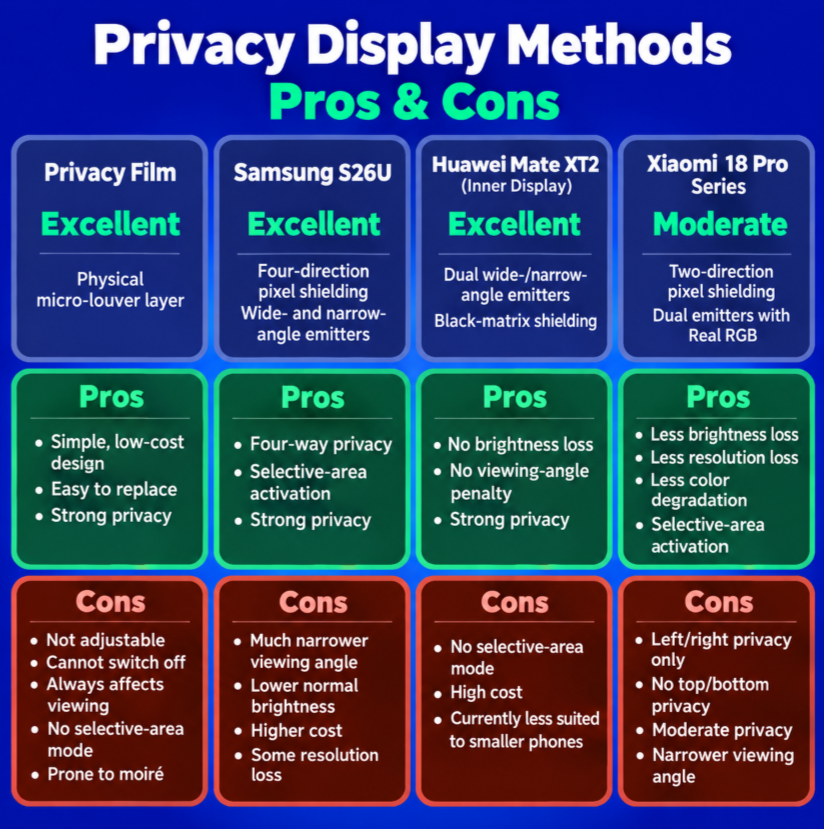
First, the industry’s first privacy-screen smartphone was Samsung’s S26 Ultra.
Its solution uses four-directional pixel light shielding, combined with wide-angle and narrow-angle pixel points (note: it does *not* employ two full sets of light-emitting units).
Advantages: excellent privacy performance when actively enabled; supports on-demand activation and even partial-area activation.
Disadvantages: significant reductions in front-facing brightness, resolution, and color fidelity after enabling privacy mode.
In short, Samsung trades substantial display quality degradation for top-tier privacy effectiveness—you can verify this firsthand at retail stores; the privacy effect is indeed strong.
Next, Huawei’s approach appears in select large-screen devices—such as the MateBook Pro S and the inner display of the Huawei Mate XT2 tri-fold.
Its solution is exceptionally ‘premium’: since tweaking a single pixel array inevitably compromises resolution, viewing angles, and color, why not simply deploy *two* independent pixel arrays?
One set optimized for wide viewing angles, another for narrow viewing angles.
Note: Huawei provides two fully independent, mutually unaffected pixel arrays. Thus, with privacy mode disabled, normal display performance remains completely unaltered.
Its drawbacks are equally apparent: no support for partial-area activation, and extremely high manufacturing costs—making it currently unsuitable for compact-screen devices.
Finally, let’s examine Xiaomi’s approach. Xiaomi’s solution is essentially a refined adaptation of Samsung’s design—a strategic ‘trade-off’.
It replaces four-directional shielding with bi-directional masking, thereby improving overall screen brightness.

Then, leveraging Xiaomi’s exclusive Super Pixel technology, it mitigates resolution loss during privacy mode activation.
However, its weakness is clear—the privacy effect is comparatively modest, as shown in the photo below, freshly captured this afternoon.
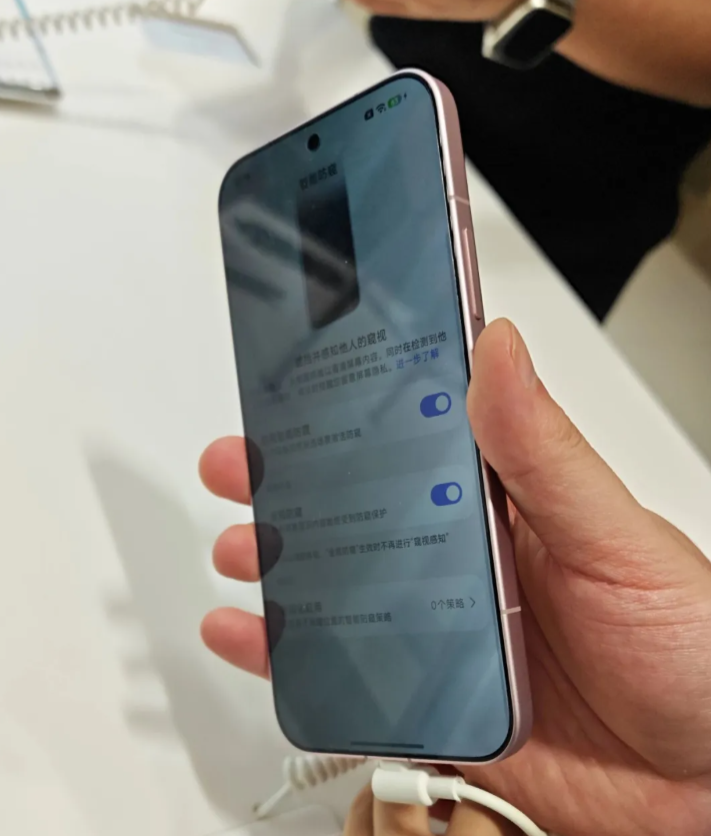
In essence, Xiaomi chose a balanced path: accepting moderate privacy performance reduction while enhancing brightness, resolution, and general viewing quality.
Still, this approach unavoidably narrows the native viewing angle during regular usage—unavoidable with current implementation.
Lastly, a brief note on *why* Xiaomi pursued this path: simple—to establish a differentiated selling point.
These days, with rising smartphone prices and diminishing innovation, identifying a compelling, consumer-appealing differentiator grows increasingly difficult.
Moreover, privacy features *do* have proven market appeal—and offline, this capability genuinely attracts buyers. That’s the core rationale.
Because the Xiaomi 18 Pro series is among the most accessible smartphones for mainstream Chinese consumers featuring active privacy mode, it truly stands out as a legitimate differentiation—fully justified.