
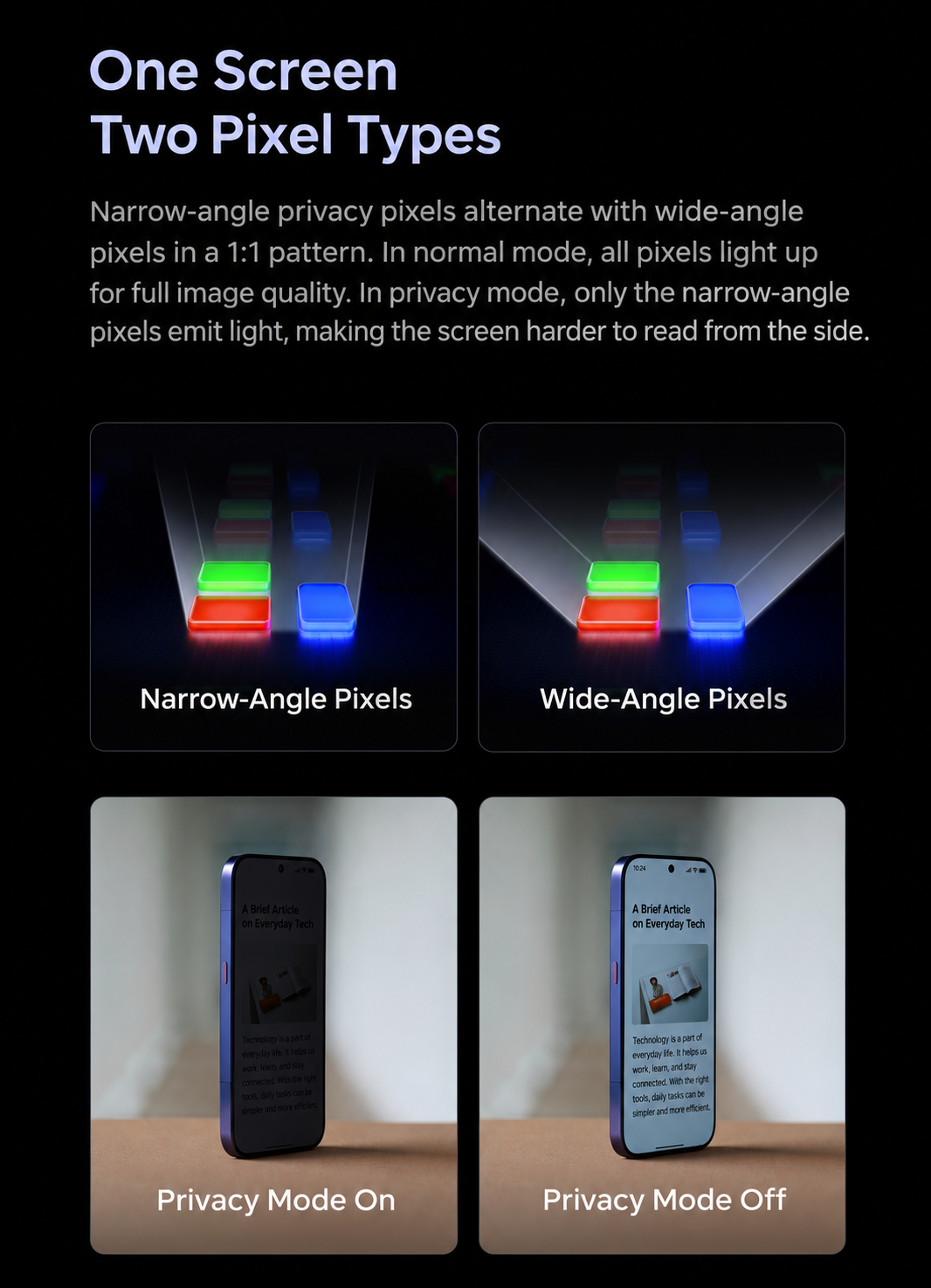
Pixel-level privacy structure on smartphone screens (reference image)
If your phone can enable privacy mode on the subway yet instantly switch to wide-view mode at home for two people to view photos side-by-side, would you still add a privacy film to your cart when buying a new device? Put another way: if your main concern is fine sand in your pocket scratching the screen, would your answer change?
These two concerns used to be addressed by one film—and one payment. Xiaomi has embedded a toggleable privacy function directly into the display of its 18 Pro series. Now, buyers have reason to consider these as two distinct purchases.
Tom Marieb, Apple’s Vice President of Hardware Engineering, once commented on screen protectors in an interview. He admitted feeling uneasy seeing an iPhone covered by a protective film—because his team had invested significant effort refining the screen’s visual experience. His remark reflects designers’ preference for bare-screen aesthetics. Yet at retail counters, customers weigh another question: What will this screen look like after one year of use?
Why Fixed Privacy Films Face Growing Pressure
Traditional privacy films apply a micro-louvered layer over the screen. Like miniature blinds, this layer permits light transmission from the front while blocking oblique light rays. As a result, bystanders find it harder to read text—but users may also perceive reduced brightness, color shifts, or graininess, depending on material quality and manufacturing precision.
Once applied, this louvered layer remains active continuously. When reading private messages alone on the subway, it delivers exactly what users paid for. But minutes later, when sharing a map with a friend, they often must physically rotate the phone toward the other person. For users frequently switching between contexts, the greatest appeal of built-in privacy lies in its on-demand usability: turn it on when needed—and off just as easily.
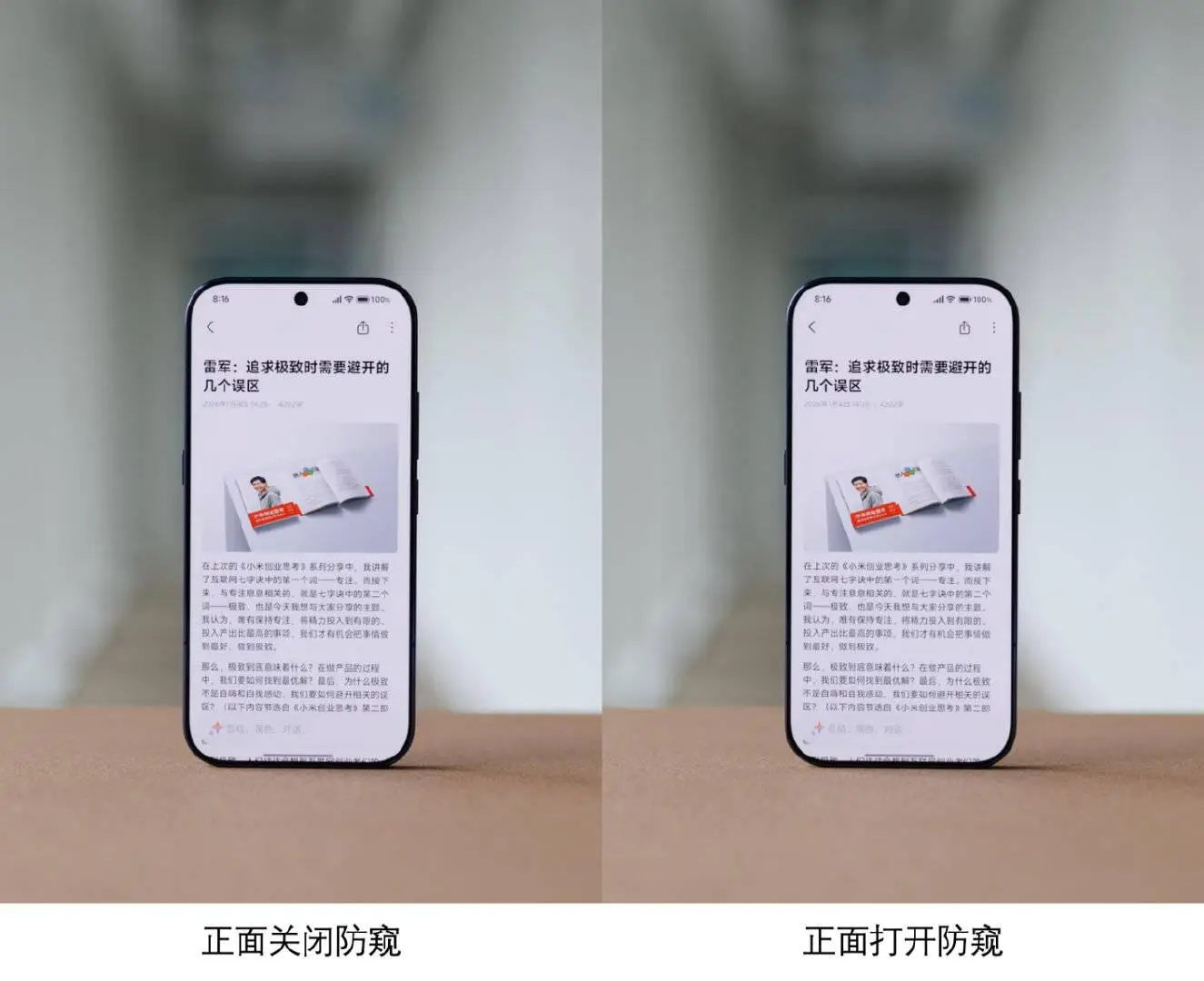
Xiaomi 18 Pro series smart privacy display comparison (original illustration)
The Xiaomi 18 Pro series interleaves wide-view pixels and narrow-view pixels across the OLED panel. During normal use, both pixel types illuminate simultaneously. In privacy mode, only narrow-view pixels emit light—reducing light emission toward left and right angles.
The difference manifests in an everyday gesture: after reading a private message in a train carriage, simply tap to disable privacy mode before turning to share photos with a friend.
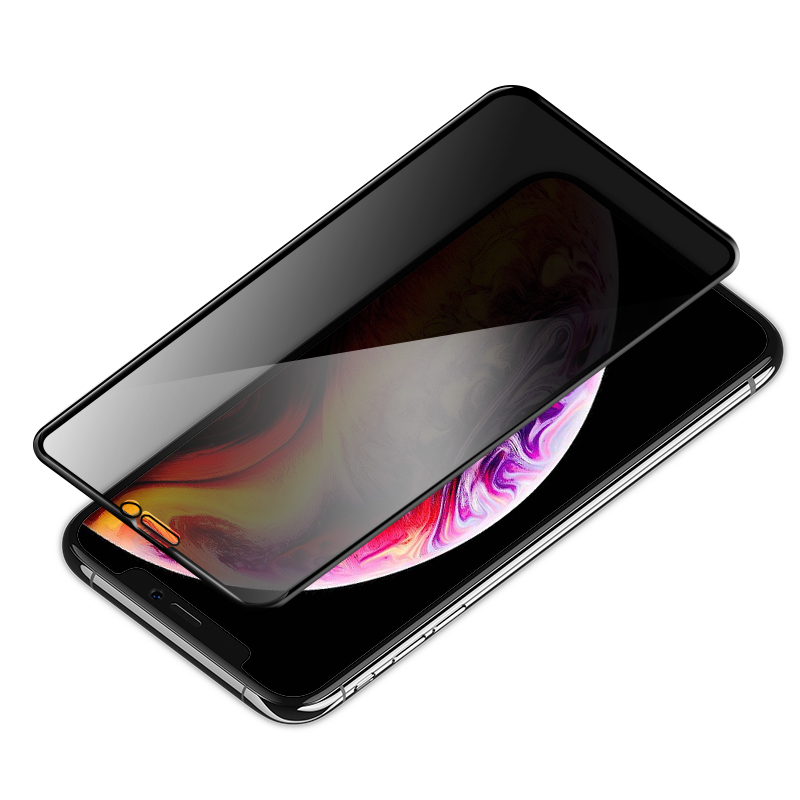
Privacy film applied to smartphone screen surface (original illustration)
When an Accessory Feature Moves Into the Display
Beyond Xiaomi, Samsung’s Galaxy S26 Ultra also offers built-in privacy display functionality. Users can manually toggle privacy mode—or configure automatic activation based on specific apps or password entry. A decision once made only once during accessory purchase now becomes a flexible, context-aware choice with every phone interaction.
This shift warrants close attention from film manufacturers. Historically, accessories filled functional gaps left by OEMs—e.g., adding privacy capability via film where the phone lacked it. Today, coordinated hardware (pixel-level light control) and software (adaptive settings) deliver identical features natively. If the phone itself provides greater convenience, films relying solely on privacy functionality must re-establish their value proposition.
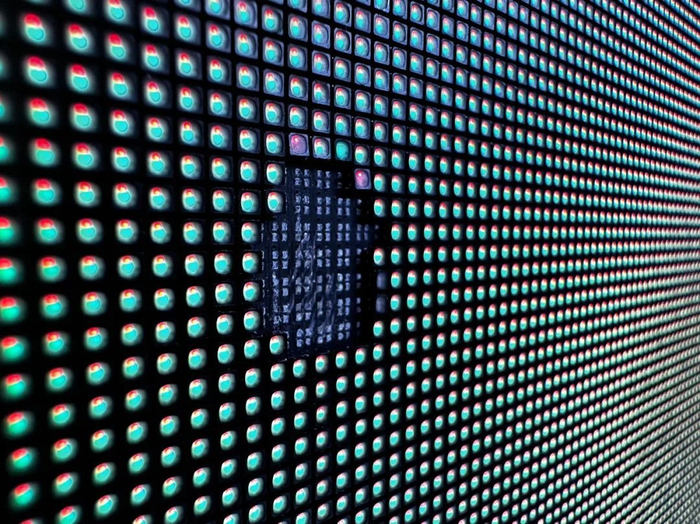
OLED pixel array structure schematic (original illustration)
Even With Privacy Displays, Daily Wear Remains Unavoidable
Back at the retail counter, buyers still face a more fundamental calculation. Even when keys and phones are stored separately, pockets inevitably collect abrasive sand particles. Once fine scratches appear on the screen, they’re visible every time the display lights up. While more scratch-resistant cover glass reduces such concerns, few users feel fully confident using their devices without protection.
A screen protector provides a replaceable interface layer. When scratched, replacing the film is far less costly and inconvenient than replacing the entire display. It absorbs routine abrasion—and in drop scenarios, whether it prevents screen damage depends entirely on impact angle and force distribution.
This explains an apparent contradiction: designers champion bare-screen aesthetics, yet Apple Stores prominently stock Belkin screen protectors—including privacy films. Some prioritize original display fidelity; others willingly pay for a replaceable protective layer.
How Film Manufacturers Can Win Orders Moving Forward
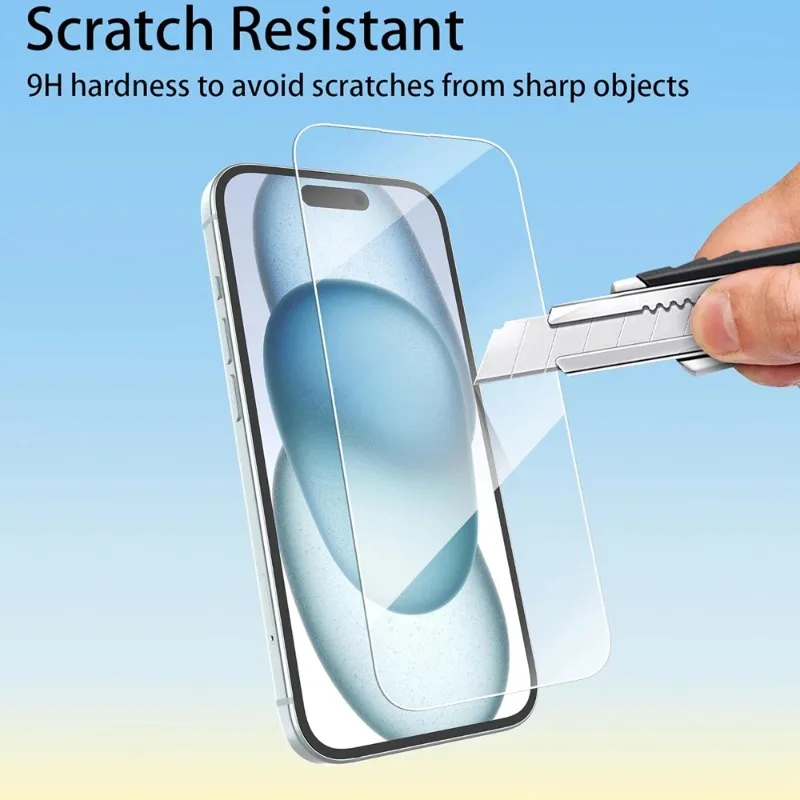
Scratch-resistant tempered-glass screen protector (original illustration)
First, consider the customer’s actual device. For models lacking built-in privacy, a well-matched film remains the most direct solution. For privacy-enabled models, customers increasingly ask: How much dimming occurs after application? Does text remain crisp and legible? Is replacement convenient after prolonged use?
These questions define R&D priorities. For privacy films, demonstrate side-view blocking efficacy alongside front-view transmittance performance. For daily-protection films, emphasize real-world abrasion resistance and ease of replacement. For professional equipment or demanding environments, proving multi-function compatibility—rather than merely adding another marketing bullet point—is far more persuasive.
The next time someone asks, “Do I need a screen protector for this phone?”, retailers can begin by asking: “What are you primarily protecting against—the gaze of others, or everyday wear?” The first depends on what the phone already delivers; the second hinges on how the user chooses to safeguard their screen. Clarify both—and the value of that film becomes unmistakably clear.